
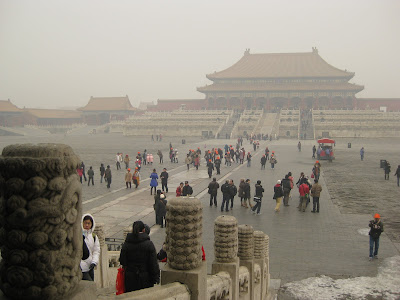
The Forbidden City is literally the centre of Beijing - just across Chang'an Avenue from Tiananmen Square, and right on the city's great north-south axis (which culminates in the Olympic Village, 16km north). Inside, it's all fantastically rigid formality and symmetry, with a series of pavilions and grand, empty squares unfolding one after the other:
 All this austerity makes the arrival at the residential part of the Forbidden City even more delightful because of its contrast to the civic areas of the complex. Here, the courtyards are smaller and more intimate, and filled with trees:

There are also smaller, whimsical structures in the residential area, such as this pavilion:

So that's your very brief Forbidden City tour. Later this week we'll visit a hutong district and the fabled Summer Palace (albeit in winter).


 Still not quite occupied is OMA's CCTV Tower, partly because the fire at the TVCC Tower to the left (which you can see charred and scarred in the photo below) set back progress. I was fascinated by the almost organic patterns of the steel structure of the main building. It reminded me of an object that had been trussed with twine to hold it up.




 The book is a series of photos of students at U.S. Ivy League campuses in the 1960s that seeks to explain the elements of preppy style. It's fantastic not only because of the way the captions refer to the students in the photographs as if they are some sort of exotic species (which, in many ways, Ivy League students still are), but because the clothes they wear are still so fashionable today.


 Williamson visited the homes of the late Charles and Ray Eames, George Nakashima, Harry Bertoia, Russel Wright (below and above), and Walter Gropius (bottom) among others.

