Entries to our annual Home of the Year award close at 5pm this Thursday March 17. As many of you already know, the Home of the Year award is New Zealand's richest architectural prize, with a first prize of $15,000. We welcome submissions from architects and homeowners.
This year we're also delighted to announce the support of our new awards partner, Altherm Windows. Altherm are also generously supporting the visit of the international member of our Home of the Year jury - whose name we will be revealing later this week.
In the meantime, you can download the Home of the Year entry form here.
Minggu, 13 Maret 2011

Selasa, 08 Maret 2011
We like: Beijing (part one)
It's Jeremy here - I've just been on holiday to Beijing and thought I'd show you some of my (very amateur) photos. The Chinese capital, of course, is justifiably well-known for the Forbidden City, the Summer Palace, the charming old hutong neighbourhoods, and many other older buildings. But China's incredible economic growth also means its capital serves up a feast of fantastic contemporary architecture. I won't show it all to you here (I'll save some other shots for subsequent posts) but here are some highlights. First, the airport, by Foster + Partners. Huge, elegant and swooping:

Almost everyone knows what Herzog and de Meuron's 'Bird's Nest' stadium looks like. Here's my favourite image that I took of it:
 Still not quite occupied is OMA's CCTV Tower, partly because the fire at the TVCC Tower to the left (which you can see charred and scarred in the photo below) set back progress. I was fascinated by the almost organic patterns of the steel structure of the main building. It reminded me of an object that had been trussed with twine to hold it up.
 Tomorrow, I'll post images of some of the other contemporary highlights of the city - buildings by Steven Holl and Kengo Kuma in particular.
Almost everyone knows what Herzog and de Meuron's 'Bird's Nest' stadium looks like. Here's my favourite image that I took of it:
Still not quite occupied is OMA's CCTV Tower, partly because the fire at the TVCC Tower to the left (which you can see charred and scarred in the photo below) set back progress. I was fascinated by the almost organic patterns of the steel structure of the main building. It reminded me of an object that had been trussed with twine to hold it up. The building didn't dominate the cityscape like the I thought it would - partly because the city is so big and because, at 54 storeys, it isn't unusually tall. But there's no getting away from it once you get into the general vicinity.
 Tomorrow, I'll post images of some of the other contemporary highlights of the city - buildings by Steven Holl and Kengo Kuma in particular.
 Senin, 07 Maret 2011
We like: Beijing (part two)
A bit more Beijing contemporary razzle-dazzle, this time Steven Holl's 'Linked Hybrid' in the city's northeast. This ring of towers (with nifty coloured insets around their windows) is joined by a series of spectacular skybridges.
 Travellers' tip: pretend to be a rich expat looking for Beijing accommodation like I did, and you can get a tour of the apartments. Or one of them, at least. The disappointing aspect of this was that the apartments were really poorly finished inside, with crap paintwork and cracked tiles in the bathrooms, as well as dust everywhere. Where's the glamour? My Beijing friends tell me this is typical of many new Beijing developments. Quality control is apparently difficult, and everything happens at breakneck speed.
 Unfortunately our tour didn't include any of the bridges, because a security guard wouldn't let us in there. Strange. Also, the swimming pool, located in one of the skybridges, isn't functional yet. A woman I met who lives there said she doubts it will ever be. I don't think that's for design reasons - she thought it was probably just because the developer had moved onto other things.


Over in the centre of town - just west of Tiananmen Square, to be exact, is Paul Andreu's National Grand Theatre, otherwise known as 'The Egg'. You have to buy tickets to a show to get into the auditoriums, and unfortunately there weren't any on the few nights I was there:

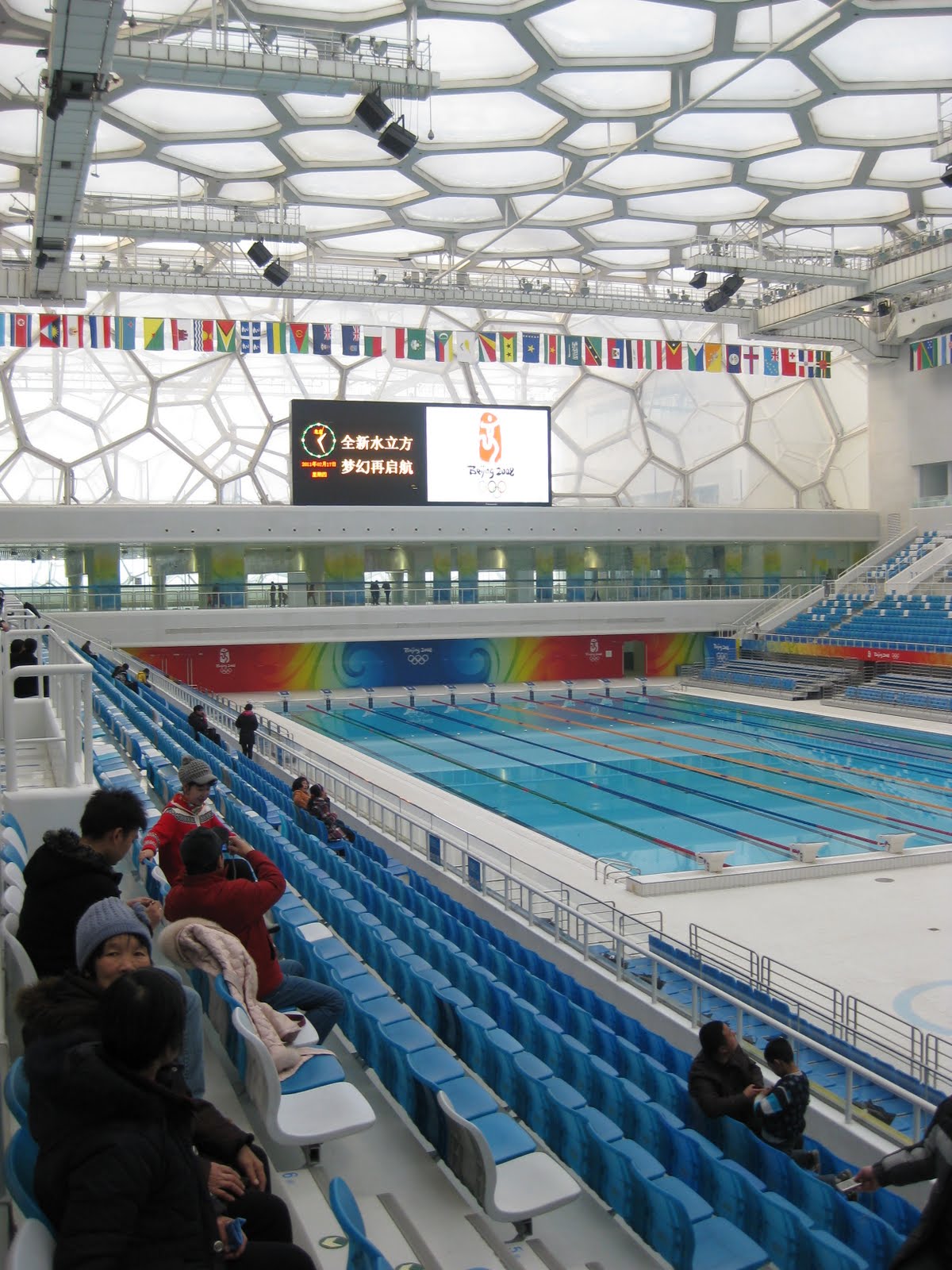
Here's a shot inside the Water Cube in the Olympic park. The building was more impressive inside than I had expected, although it's already showing terrible signs of wear and tear, and it's less than three years old:

This is a building by Kengo Kuma in the area of Sanlitun, a cool restaurant and shopping area in the eastern embassy district. Kuma also helped out with the masterplanning of this 'village', which aims to replicate the feel of the alleyways of the city's old hutong districts. To me, it seemed like a really successful way to group retail and food outlets in a contemporary way without resorting to a mall-like structure. Here, you had to go outside to move between shops and eateries:
 Also by Kengo Kuma is The Opposite House, one of the hotels I stayed in (which is just north of the village complex pictured above). The hotel's terrific (as is the Sanlitun area generally), and highly recommended.
 Still to come - shots of the older parts of Beijing, as well as the 798 art district. I'll post them sometime soon.
 Travellers' tip: pretend to be a rich expat looking for Beijing accommodation like I did, and you can get a tour of the apartments. Or one of them, at least. The disappointing aspect of this was that the apartments were really poorly finished inside, with crap paintwork and cracked tiles in the bathrooms, as well as dust everywhere. Where's the glamour? My Beijing friends tell me this is typical of many new Beijing developments. Quality control is apparently difficult, and everything happens at breakneck speed.
 Unfortunately our tour didn't include any of the bridges, because a security guard wouldn't let us in there. Strange. Also, the swimming pool, located in one of the skybridges, isn't functional yet. A woman I met who lives there said she doubts it will ever be. I don't think that's for design reasons - she thought it was probably just because the developer had moved onto other things.

Over in the centre of town - just west of Tiananmen Square, to be exact, is Paul Andreu's National Grand Theatre, otherwise known as 'The Egg'. You have to buy tickets to a show to get into the auditoriums, and unfortunately there weren't any on the few nights I was there:

Here's a shot inside the Water Cube in the Olympic park. The building was more impressive inside than I had expected, although it's already showing terrible signs of wear and tear, and it's less than three years old:
This is a building by Kengo Kuma in the area of Sanlitun, a cool restaurant and shopping area in the eastern embassy district. Kuma also helped out with the masterplanning of this 'village', which aims to replicate the feel of the alleyways of the city's old hutong districts. To me, it seemed like a really successful way to group retail and food outlets in a contemporary way without resorting to a mall-like structure. Here, you had to go outside to move between shops and eateries:
 Also by Kengo Kuma is The Opposite House, one of the hotels I stayed in (which is just north of the village complex pictured above). The hotel's terrific (as is the Sanlitun area generally), and highly recommended.
  Still to come - shots of the older parts of Beijing, as well as the 798 art district. I'll post them sometime soon.
 Minggu, 06 Maret 2011
We like: Take Ivy
We're silly about Take Ivy, the recently republished 1965 book by Japanese photographer Teruyoshi Hayashida with text by Shosuke Ishizu, Toshiyuki Kurosu and Hajime Hasegawa.
 The book is a series of photos of students at U.S. Ivy League campuses in the 1960s that seeks to explain the elements of preppy style. It's fantastic not only because of the way the captions refer to the students in the photographs as if they are some sort of exotic species (which, in many ways, Ivy League students still are), but because the clothes they wear are still so fashionable today.

The book's blurb says that when it was originally published, it set off an explosion of American-influenced "Ivy Style" among students in Tokyo. If you've been to Tokyo, it's easy to suggest that this so-called explosion is still reverberating today - although you could also argue that the way Japanese fashionistas have tweaked preppy style means they have turned it into a style all their own.
 However, this is now, and that is then - and we recommend Take Ivy as a completely charming time capsule (and a very good gift for your favourite prep fans). It's published by Powerhouse Books. We got our copy at Auckland's Unity Books.

The book is a series of photos of students at U.S. Ivy League campuses in the 1960s that seeks to explain the elements of preppy style. It's fantastic not only because of the way the captions refer to the students in the photographs as if they are some sort of exotic species (which, in many ways, Ivy League students still are), but because the clothes they wear are still so fashionable today.
The book's blurb says that when it was originally published, it set off an explosion of American-influenced "Ivy Style" among students in Tokyo. If you've been to Tokyo, it's easy to suggest that this so-called explosion is still reverberating today - although you could also argue that the way Japanese fashionistas have tweaked preppy style means they have turned it into a style all their own.
 However, this is now, and that is then - and we recommend Take Ivy as a completely charming time capsule (and a very good gift for your favourite prep fans). It's published by Powerhouse Books. We got our copy at Auckland's Unity Books.
Kamis, 03 Maret 2011
We like: Cafe Hanoi
We're big fans of Auckland's Cafe Hanoi, not only for its fantastic Vietnamese street-style food, but for the beautiful interior of the building the restaurant occupies in Auckland's Britomart Quarter. When you consider the disrespect Auckland has generally had for its old buildings, it's a delight to see a 130-year-old warehouse as cleverly refurbished as this. The restaurant is featured in our current issue of the magazine. These images are from Jeremy Toth's shoot.

Nat Cheshire of Cheshire Architects wanted to preserve the integrity of the existing structure and the layers of history it contained. So paint was scraped back and left exposed, while the room was fitted out with paper lanterns and red-painted, reupholstered vintage chairs.


Cafe Hanoi is one of those rare restaurants where, if the need arises, you can feel very comfortable dining alone, especially if you sit at the bar with its view of the kitchen.

As the restaurant doesn't take reservations in the evening (apart from large groups - it does take lunch reservations), the bar is also the place to wait at for a table. You never have to wait for long, and the view of the bustling, beautifully decorated room makes the time seem to pass quickly anyway. We suggest you visit as soon as you can.
Nat Cheshire of Cheshire Architects wanted to preserve the integrity of the existing structure and the layers of history it contained. So paint was scraped back and left exposed, while the room was fitted out with paper lanterns and red-painted, reupholstered vintage chairs.
Cafe Hanoi is one of those rare restaurants where, if the need arises, you can feel very comfortable dining alone, especially if you sit at the bar with its view of the kitchen.

As the restaurant doesn't take reservations in the evening (apart from large groups - it does take lunch reservations), the bar is also the place to wait at for a table. You never have to wait for long, and the view of the bustling, beautifully decorated room makes the time seem to pass quickly anyway. We suggest you visit as soon as you can.
Rabu, 02 Maret 2011
We like: Handcrafted Modern
Our current favourite book is Handcrafted Modern, by American photographer and writer Leslie Williamson, who visited, photographed and wrote about some of the most memorable US homes owned by modernist architects and designers.
 Williamson visited the homes of the late Charles and Ray Eames, George Nakashima, Harry Bertoia, Russel Wright (below and above), and Walter Gropius (bottom) among others.

As a whole, the book offers a counterpoint to anyone who suggests modernist design is minimal and cold-hearted, as all of the homes featured in it are warm, humane and utterly seductive.
Leslie Williams has posted outtakes from some of her shoots, as well as other work, on her blog, http://lesliewilliamsonphoto.blogspot.com/ But the beautifully produced book is the thing we like the best.
Senin, 28 Februari 2011
Design Awards 2011 with Daniel Le Brun
We're now calling for entries for our Design Awards 2011, which close on Thursday March 24, 2011. The entry form is in our current issue of the magazine.


Langganan:
Postingan (Atom)